
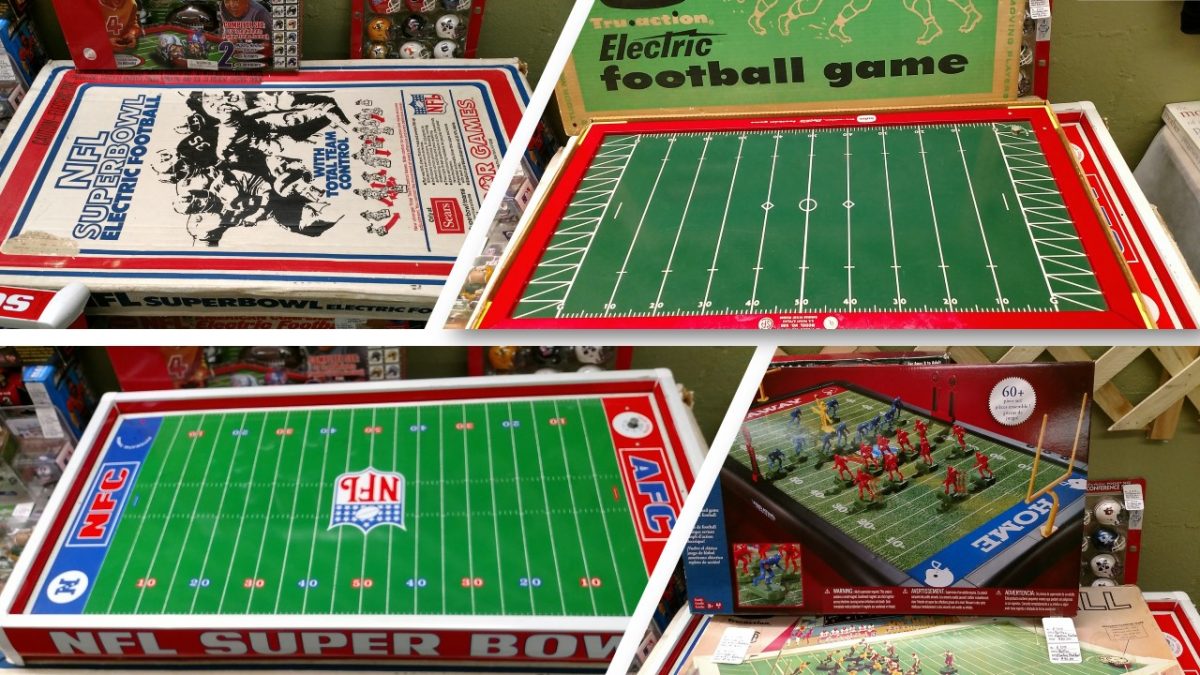
This is an update to a previous blog post published in March of 2024.

ELECTRIC FOOTBALL and the
Miniature Professional Football League (MPFL)
ELECTRIC FOOTBALL is the tabletop sports board game of American Gridiron Football first created and developed by the toy company of Tudor Metal Products Corporation and its Owner / President Norman Sas sometime in between when he first took over the company from his father, Elmer Sas, in 1947 and when the game was introduced to the toy and game market in 1949.
I think that it is important to understand that the game of electric football was created to be a kid’s toy, first and foremost, and a more modern, for the times, version of a sports board game, building on the technology of a “vibrating propelling device” invented and patented (US Patent #2167985) by Eugene Levay, an employee of Tudor Metal Products Corporation, applied for in 1937 and published in 1939.
Tudor first used this technology to create, develop and market a game of auto racing, in 1940, and then later, a game of horse racing. It was Norman Sas who decided to use this same technology to create the game of electric football and to whom history has regarded and credited as being the inventor of the game.
Norman Sas would continue to develop and improve the game and with the help of a young industrial designer, Lee Payne, finally come up with the most iconic version of the game, Tudor’s 1967 Model # 620 “NFL ELECTRIC FOOTBALL Game complete with NFL licensed team name and logo graphic game board designs and teams of figures painted in NFL “Official Team Color” uniforms.
It is this concept of presenting the “NFL in Miniature” that ultimately led to the creation and development of the “Miniature Professional Football League” / MPFL by Anthony D. Burgess.
So, What is the MPFL?
In my words, and from everything that I have read, researched, and experienced in attempting to play electric football by this MPFL system of the game, and that I have come to the following conclusion of is this, that:
The MPFL is a system of playing the game that is a “multi-stop” (start and stop) of “live ball” game play action, “read and react” (offense reads the defense, defense reacts to the offense) style of movement (direction, redirection, adjustment and readjustment) of players until the ball next becomes dead.
In my opinion, the MPFL is the most realistic style of electric football game play that has ever been created and developed, that fully incorporates all the core elements of the actual real-world game of American Gridiron Football as it was originally intended to be played. This can only be made possible if a game of electric football also consists of those core elements of actual real world American Gridiron Football.
It is also probably important, at this point, that I should also add that this opinion also comes from several long hours of back-and-forth conversations by Facebook EF group posts and replies, private text and messages, and personal phone calls with Anthony Burgess as the MPFL’s creator.
WHAT ARE THE CORE ELEMENTS of AMERICAN GRIDIRON FOOTBALL
According to an AI generated answer when asked that question on Google:
“American Gridiron Football is a strategic, contact sport played between two teams of 11, aiming to outscore opponents by advancing an oval ball into the end zone (6-point touchdown) or kicking through goalposts (3-point field goal). Key elements include the 100-yard field, 4-down system, specialized units, and passing/running plays.
Core Elements of American Football:
- Objective: To score more points than the opposing team within four 15-minute quarters.
- The Field (“Gridiron”): A 100-yard field (plus 10-yard end zones on each side) featuring yard lines marked every 5 yards, creating a grid pattern.
- Downs System: The offense has four attempts (“downs”) to advance the ball at least 10 yards to gain a new set of downs.
- Scoring:
- Touchdown (6 points): Moving the ball into the opponent’s end zone.
- Field Goal (3 points): Kicking the ball through the goalposts.
- Extra Point/Two-Point Conversion (1 or 2 points): Attempted immediately after a touchdown.
- Safety (2 points): Tackling an offensive player in their own end zone.
- Teams and Positions: 11 players per side on the field, with distinct squads for offense (scoring), defense (stopping the offense), and special teams (kicking situations).
- Game Play Mechanics:
- Snap: Every play begins with the center snapping the ball to the quarterback.
- Running/Passing: The ball is advanced by running with it or passing it forward (one forward pass allowed per play).
- Tackling/Blocking: Defenders tackle the ball carrier to stop progress, while offensive players block defenders to create space.
- Equipment: Players wear helmets, shoulder pads, and protective gear to manage high-impact collisions.
- Key Penalties: Infractions like offsides, holding, or unnecessary roughness result in loss of yardage or downs.
If your ELECTRIC FOOTBALL game play procedures do not make provisions for the above “core elements” then you are playing a form of the game that is not holding true to the way electric football was intended to be played.
Again, quoting Google AI:
Original Tudor Electric Football rules (c. 1948-1960s) revolved around setting up 11 plastic players on a vibrating metal field to run, pass, and kick, simulating real football. Plays were initiated by flipping a switch, with players, often featuring “rookie” bases, moving based on vibrations. A tackle occurred when a defender’s base touched the ball carrier’s base.
Key components of the original gameplay included:
- Setup: Coaches, acting as managers, positioned their 11-man teams in offensive and defensive formations, often using strategies like setting up blocking angles.
- The Play: The field vibrates, causing players to move. The offense aims to advance the ball, while the defense tries to stop them.
- Passing: Original passing involved placing the ball on a specific passing quarterback figure and using a measuring stick to determine completion, often allowing defensive adjustments.
- Kickoffs/Field Goals: A special “kicker” figure was used to kick a plastic felt-covered ball, aiming for goals.
- Rules: The rules were intentionally similar to American football, featuring four quarters, downs, and special teams, with an emphasis on strategy and, in later years, specific “Tudor Advanced Play” (TAP) rules.
The game has evolved over time, but the core mechanic of using vibrations to move plastic figures on a metal surface has remained consistent.
I don’t put a lot of stock in AI generated content, because, as evidenced by thoroughly examining the above, as it relates to my knowledge and understanding of electric football:
- Yes, electric football revolves around simulating real football, and
- Yes, it is played on a vibrating metal field with teams of 11 “players” typically made of plastic, that can be made to ” run, pass, and kick”.
- Yes, play is initiated by activating the vibration of the game board that sends everything into motion, and
- Yes, the base is that part of the player that determines how that specific player will react to the vibration of the game board and is the determining factor in whether or not a player has been tackled or not.
All true statements but very general in nature.
Getting into the “key components” of the original gameplay:
- Setup: Coaches, acting as “managers” positioned their 11-man teams in offensive and defensive formations, often using strategies like setting up blocking angles.
- The more modern terms here would be “offensive and defensive coordinators”, “setting up” their 11 “player” teams in offensive and defensive formations, often using strategies like setting up “offensive lineman to block at certain angels, offensive backfield players and end line receivers angled to move in specific directions, and allowing numerous pre-snap motions, pivots, and adjustments with the defensive lineman also being angled to rush in certain directions, linebackers and defensive backs falling back into specific areas of pass coverage and defensive schemes, also with numerous pre-snap counter motions, pivots and adjustments to counter those of the offense.
- The Play: The field vibrates, causing players to move. The offense aims to advance the ball, while the defense tries to stop them.
- Not really anything that needs to be changed or clarified here. This is a statement that reflects the basic core element objective to score more points than the opposing team within four 15-minute quarters of American Gridiron Football
- Passing: Original passing involved placing the ball on a specific passing quarterback figure and using a measuring stick to determine completion, often allowing defensive adjustments.
- “Using a measuring stick to determine completion, often allowing defensive adjustments” is a method of passing that has only become more popular and acceptable in recent years. It was first created and developed by Anthony Burgess approximately 25 years ago in his original development of the MPFL.
- There has always been a quarterback figure included with the game that could not only pass the ball but also kick the ball. It is more often and commonly referred to as the Triple Threat Quarterback or TTQB. The ball used in electric football is a small oval-shaped piece of felt or foam rubber that has a slit in one end that allows it to be placed on the throwing arm of the TTQB for passing and placed on the kicking tee of the TTQB for kicking. Other versions of the game made by other manufacturers of the game have, at times, used balls made of wood and /or magnets but no matter by which one, they have all always had a specifically designed and constructed figure that could pass and kick a “ball”.
- Kickoffs/Field Goals: A special “kicker” figure was used to kick a plastic felt-covered ball, aiming for goals.
- The “ball” has never been, to my knowledge, a “plastic felt-covered” ball.
- Rules: The rules were intentionally similar to American football, featuring four quarters, downs, and special teams, with an emphasis on strategy and, in later years, specific “Tudor Advanced Play” (TAP) rules.
- TRUE!! But it was also suggested that the rules could be changed and/or added to, to make the game more realistic and interesting to play. Which is exactly what has now happened. There are now literally thousands of ways that the original rules of electric football, as first written by Tudor developers, have been changed and / or added to, to make the game more realistic and interesting to play. AND … that “Tudor Advanced Play” (TAP) rules are just one of.
- “Tudor Advanced Play” (TAP) rules are the creation of current Tudor Games owner, Bryan Nutt, and first introduced in 2024 as an alternative rule set to be used in Tudor Games sponsored tournaments.
The game has evolved over time, but the core mechanic of using vibrations to move plastic figures on a metal surface has remained consistent.
- An “Absolutely True” undeniably, unquestionably correct statement.
THERE is NO RIGHT or WRONG WAY to PLAY ELECTRIC FOOTBALL
It has always been my notion that “there is no right or wrong way to play electric football” which has led me to often state “Just Have Fun and Play the Game.”
Well, there is a right way to play!! OK??, There, I said it. There are many variations of the game of gridiron football that have been developed beyond that of traditional gridiron football with the first that comes to my mind being that of how American Gridiron Football is played on the professional, college, and high school levels. Then there is American Football vs Canadian Football. But also let us not forget Arena football and Six-, Seven-, Eight-, and Nine- Man Football. And now there is the ever more growing in popularity Flag Football, which to me, is just another form of the two-hand touch, backyard and schoolyard football we all grew up playing as kids.
Even Gridiron Football was developed from the original game of Rugby Football, which developed from Association Football, more commonly known as “soccer”. The historical first game of college football played in the United States, in 1869, between Harvard and Rutgers was in fact, actually Association Football, which made no provisions for picking up the ball and running with it and the only passing of the ball was done with the foot by kicking it to another player.
But, yet, they all have at their very core, a game that is played with a ball that must be possessed and advanced down a playing field by some form of movement in an attempt to score more points than your opponent. That is all it takes to play real world football and thusly, electric football.
THE MPFL – MINIATURE PROFESSIONAL FOOTBALL LEAGUE
I am not sure exactly when the MPFL came into being, but I think that it was in the early 2000’s when I first was getting back into the game and hobby, that I heard about or read some things about it. I did in a recent conversation with Anthony Burgess discover that we had both been in attendance at an ELECTRIC FOOTBALL tournament event, the BAMA BLAST, in Birmingham, AL, in June of 1999. This was the first major regional EF tournament that I was able to attend after having traveled to Philadelphia, PA to attend my first National ELECTRIC FOOTBALL Convention and Super Bowl Tournament in the winter of 1999. This was the 5th such EF event sponsored and hosted by the then makers of the game, Miggle Toys / Tudor Games that had evolved from its first National Championship of ELECTRIC FOOTBALL, in 1995, held in Chicago, IL.
In a recent Facebook post, Anthony shared this MPFL EVOLUTION:
Posted on January 29th, 2026, on the MPFL Private Facebook Group.
MPFL EVOLUTION
A little photo history that started roughly around 1997/98 years before Vance and I met. There are so many haters around not knowing how long I been around and playing long before they came back into the hobby.
Back then known as the PEFL the system was created on a 620 board and later moved to a true scale size board.
During this time no one was stopping the board more than one time, there was zero alternative passing methods, no adjusting players, no read and react, no turn and burn. So many guys including the haters don’t realize that how they are playing came from many of my ideas and concepts. You see things are and start using them not knowing where it came from and think that’s just how it’s played, not knowing the guy you hate on is behind how you’re playing today.
Every idea and concept was well thought out and tested for weeks or months before finishing and used in the now known MPFL. Every single MPFL aspect and idea was designed to work together within the MPFL, but aspect removed wouldn’t work properly outside the MPFL. Think of it as a failsafe, you steal an idea or concept and try to fit it into what you do, not knowing the fine nuances and delicate balance needed in order for it to work properly.
This was never about recreating the nostalgia of a childhood toy, but all about creating an entirely new Adult Sports Strategy Football Game Simulation using the parts of ELECTRIC FOOTBALL. Always looking ahead and not being stuck in the past or incarcerated by nostalgia as many in this hobby are. Electric Football IS NOT real football and anyone that’s honest can see that and it’s ok that it’s not real football
But you shouldn’t lie to guys and tell them it is! Even though they will not admit it, but the fact that you are turning/adjusting players, turn and burn, stick passing, freeze frame/stand still base, adding fumble man, among others, all came from the MPFL regardless if the(y) accept it or not that’s where it all came from.
And it didn’t occur until the MPFL was introduced at the Baltimore Miggle Convention. Where the MPFL DVD was sold. Guys purchased it and used what they liked from it!
Why am I telling you this? So, you know what has been hidden from you all this time and for new guys coming into the hobby. This is my life’s work and I’m always looking for ways to improve it.
I’ll leave you with this advice…….. Get yourself a scale size board like what I have! Get ahead of what’s to come. The future of the hobby isn’t with small board(s) it’s going to be scale size boards. Make the investment now or you’re going to pay double or triple that in the near future.
Take care and thanks for taking the time to read this especially the haters and detractors, I’m sure you will find something about this to hate on.
The photos that accompany this post can be found by following this link: https://www.facebook.com/share/p/1DorVenUrC/?mibextid=wwXIfr
So, again – What is the MPFL?
This is how it is defined in the ABOUT statement on the MPFL Facebook Group page:
MPFL is football played with miniatures. This raises electric football from the basic game of checkers to the MPFL game of chess. It’s a procedural based structure that transforms electric football into an entirely new game.
The foundation of MPFL is the NFL rulebook. The procedures allow you to simulate every aspect of NFL football on a miniature field with equipment you already own from playing electric football. Make no mistake though, this isn’t your grandfather’s electric football game. It is a first of its kind, hands on football simulation played with miniatures.
MPFL doesn’t use the TTQB in the passing game like the old electric football as the TTQB is not consistent with the play structure of the MPFL. Instead, MPFL uses a sophisticated pass placement system that incorporates every element of NFL passing action. If you experience it on Sunday with the NFL, you will experience it here in the MPFL!
I probably should have started this essay with the above statement, but honestly, I just like writing and expressing my own views on a subject first, I guess. After years of trying to find a copy of the MPFL DVD and pleading with Anthony to make it available again for sale, I was given one in some donations from former MFCA President, Lynn “Weirdwolf” Schmidt, along with another set of DVD’s made by “ELECTRIC COACH” Renee Smith or “Coach Smitty” as he is more often known, a staunch supporter and proponent of the MPFL system of ELECTRIC FOOTBALL Game Play.
It is actually Coach Smitty that I owe for giving me the idea of starting an ELECTRIC FOOTBAL Game Museum and for his encouragement that has been the inspiration behind starting it, whether he realizes it or not. But that is a whole nother story and maybe the subject of a future blog post.
For now, take care, may God bless, “Keep on buzzin’” and “Just Have Fun and Play the Game”.

 The National Electric Football Game Museum